Thursday, September 20, 2012

Review: Ruby Sparks (2012)


Directors: Jonathan Dayton and Valerie Faris
Writer: Zoe Kazan

In 2006, Jonathan Dayton and Valerie Faris burst onto the scene with their feature film directorial debut, Little Miss Sunshine. It was a poignant film that celebrated the quirks of a dysfunctional family. Fast forward six years, and they have returned to the screen with Ruby Sparks—a film that is not as quirky or cohesive as the couple's debut, but still works as a piece of escapism. While this is Dayton and Faris' second directorial effort, it is Zoe Kazan's debut as a screenwriter.  


Paul Dano stars as Calvin, an author in his late 20s who is plagued by writer's block. Calvin wrote an acclaimed novel at the age of 19, so he has great standards to live up to. Lacking inspiration, he seeks advice from his therapist, Dr Rosenthal (Elliott Gould), who assigns him with a writing task. Calvin is instructed to write a page about someone who finds his pet dog, Scotty, adorable. Calvin isn't exactly fond of his dog, so this is a potentially challenging assignment. That night, Calvin dreams that he is walking Scotty in a park when he encounters the girl of his dreams (Zoe Kazan). She draws a picture of Scotty, and says she likes him. Upon waking, Calvin rushes to his typewriter and writes several pages about this gorgeous woman. His epiphany has arrived. He gives this wondrous beauty the name 'Ruby Sparks', and makes her the protagonist of his next novel. He soon realises that he is enthusiastic about working on this new project because, when he writes about Ruby, he feels like he's spending time with her. It doesn't take long for Calvin to bring Ruby into fruition, and by this, I mean Ruby Sparks is "written into" existence by Calvin. She becomes a living, tangible person, and Calvin can make her do anything just by typing her actions on the page. It takes Calvin a while to accept this, and his brother (Chris Messina) thinks he's crazy. Calvin and Ruby enter into a relationship which will contain several ups and downs.

This is a film to watch if you are after a breezy escape, but it just falls short of being the study of the human condition that it probably hoped to be. Much of Kazan's dialogue is stuff we've heard a thousand times before in similar movies. but she'll improve as she gets some more writing experience under her belt. My main criticism of the film is how the central gimmick is employed. Calvin can make Ruby do absolutely anything simply by typing it out on his typewriter. This gimmick allows so many possibilities, and at 104 minutes' long, the film doesn't have the time to explore this plot device to its fullest potential. I'm not necessarily saying that Calvin should have made Ruby do more things, but rather that he could have made her do more interesting things. It is worth considering the reflexive nature of this film. Here we have Zoe Kazan inventing a character (Calvin) who will invent the character Ruby Sparks, who Kazan herself will portray. It would have been challenging to pull this off, so I admire Kazan's ambition. 


And what about the character of Ruby Sparks? I watched the film and associated her with the Manic Pixie Dream Girl archetype. She reminded me of Summer (Zooey Deschanel) in (500) Days of Summer, or Ramona Flowers (Mary Elizabeth Winstead) in Scott Pilgrim vs. the World. Kazan has dismissed the archetype as a myth, deeming it misogynist and wishing for its death. If Ruby is a Manic Pixie Dream Girl, I'd put the onus on Calvin as a character, and not on Kazan as a writer. 

This film reminded me of Marc Forster's Stranger Than Fiction, in which Will Ferrell starred as a man whose life was being narrated by a disembodied voice. However, Ruby Sparks isn't as metaphysical as Stranger Than Fiction. The latter concerns itself with the dynamics of comedy and tragedy, whereas the former places more emphasis on the affordances of fiction, and provides the audience with hope for serendipity. I also noticed a slight parallel between Ruby Sparks and Frankenstein. I won't give it away in this review, but it has something to do with the sentience and self-actualisation of a creation. Stephen King fans may also be reminded of the short story Word Processor of the Gods.

This is not a performance-driven film, but the acting is as strong as it has to be. I've seen Paul Dano in a few films now, but this was the first time I've seen him give a comedic performance. He is a good physical comedian, but I think he is better suited to dramatic performances. Zoe Kazan is mesmerising, and you will fall in love with her just as Calvin does. Annette Bening plays Calvin's mother: an adherent of New Age philosophy, and Antonio Banderas plays her equally eccentric partner. Bening and Banderas are sorely underused, and it almost felt as though they were included as filler.  

Ruby Sparks tries harder than most romantic comedy-drama films these days. It tackles the dilemma of the artist who cannot decide whether to produce work for their ego or for an audience. It deliciously tiptoes on the border of fantasy and reality, and presents the idea that the creative autonomy of an artist negates the need for such a strict binary. The problem is that these issues are addressed through the gimmick of the all-powerful typewriter, which stalls the fluidity and evenness of the film.

3.5/5 stars. 

===================================================================

Postscript: This will go down in history as the first movie I saw by myself at a cinema, believe it or not. There were only five other people who attended the session—all girls around my age, and all seated within a five-metre radius of me (including one who sat right next to me). As you could imagine, I was living vicariously through the character of Calvin. A very interesting, self-aware viewing experience. 

Tuesday, September 4, 2012

Top 10 Scariest Scenes That Are NOT from Horror Films

One of the great pleasures of going to the movies is being frightened. There's a tantalising thrill that comes with being scared when you know the source of that fear is purely fictitious. Most of us seek such a thrill through horror films, but the horror genre does not have a monopoly on creeping audiences out. In fact, any film can contain at least one scary scene, and it doesn't have to be 'monsters in the dark' scary. It can be scary because it reminds us of an inconvenient truth, or reflects the ugliness in society. Here are ten scenes that scare me each time I watch them, and none of them come from horror films (none of these films have 'horror' listed as a genre on IMDb). So, time to begin the countdown...from least scary to scariest, and YES, there are some spoilers in here. You have been warned.

10. Matilda and Miss Honey trespass on Miss Trunchbull's property (Matilda, Danny DeVito, 1996) 


I'm guessing you're surprised this scraped in on the list. Matilda has a reputation for being one of the most intense family films, and it's not hard to see why with a character like Miss Trunchbull. Granted, this scene doesn't scare me as much if I watch it today, but I can't tell you how much this petrified me as a child. I've always thought that Miss Trunchbull is similar to a possessed Regan MacNeil from The Exorcist, in the sense it's scary just to look at her. Her imposing figure and those vengeful eyes make for one terrifying antagonist, considering the film's target audience. All I could think of as a child was how idiotic Matilda must be. Sure, she's well-read in Charles Dickens, but she's not smart enough to know that trespassing on your evil principal's property is a bad idea. (Note: the full scene is not on YouTube; the above clip is the best I could find).

9. Woody and the gang almost get incinerated (Toy Story 3, Lee Unkrich, 2010)


I've said it before, and I'll say it again. Never before have I cared so strongly for hunks of plastic as I did while watching the Toy Story films. This was the scene that made me realise how excellent this franchise is. I love that the writers took the gamble on such a scene. I seriously thought they were going to perish, and in my head I was repeating "Not like this; not like this." Thankfully, they did not, and the ending is so touching it's beyond words. There was a moment in this scene where I had to remind myself I was watching an animated film. All the toys seemed like real people, staring down their own mortalities. I am just so glad they made it out alive.

8. "Feed me, Sara." (Requiem for a Dream, Darren Aronofsky, 2000)


Requiem for a Dream is one of the most disturbing films I have seen in my life, and it is Sara's (Ellen Burstyn's) story arc which is the saddest in the film. Here is a woman who lives alone and spends most of her day watching infomercials. When she receives an invitation to be a contestant on one of her favourite game shows, she is over the moon. In an attempt to look youthful and fit into an old favourite dress of hers, Sara begins taking weight-loss amphetamine pills. Despite her son's warning, the pills begin to dictate Sara's thoughts in a seriously dangerous way. In this scene, the lines between fantasy and reality have blurred. This is a hallucination where everyone and everything is loud and menacing. 

7. Curb stomp (American History X, Tony Kaye, 1998)


If I were making a list of the most disturbing scenes from films, this would probably make the top five. In terms of being scary, this scene is frightening due to the complete lack of remorse shown by Derek (Edward Norton). As a neo-Nazi, his compassion does not extend to anyone who isn't white. It's the scraping sound we hear at the five-second mark (in the clip) that sends a shiver down our spines. Teeth on the gutter, we know the fate that awaits Derek's victim. It is also very sad to see Derek's little brother (Edward Furlong) look on in despair. 

6. Pyle's murder-suicide (Full Metal Jacket, Stanley Kubrick, 1987)


(The scene begins at 1:00 in the clip, but you may want to watch the whole video for some context)

"Seven-six-two millimetre. Full...metal...jacket." And with those words, Private Pyle confirms that his rifle contains live rounds. We feel sorry for him. Of all the Vietnam War recruits in the Parris Island training camp, he is the most unfit; the most ridiculed. Gunnery Sergeant Hartman (R. Lee Ermey) takes no prisoners, and he lets Pyle know this straight away. After receiving a humiliating beating from his comrades, Pyle becomes a model Marine, but it's too late. The psychological damage has been done. Pyle has lost his grip on the real world, and so he kills Hartman before killing himself. Tragic scene. 

5. Bill is followed by a mysterious man (Eyes Wide Shut, Stanley Kubrick, 1999)


First of all, let me just say how beautiful the atmosphere is in this scene. New York City shows up beautifully at night, and Kubrick didn't waste the opportunity in his final film before his death. Being followed is an intrinsic human fear (unless we're talking about Twitter). No one wants it to happen to them. Although we, as viewers, are on the safe side of the camera, we still feel as though this man wants something from us. Something we cannot supply to him. It's just an expertly crafted scene, and the piano music (Ligeti's Musica ricercata) is absolutely haunting. 

4. Alex and his droogs invade Mr Alexander's home (A Clockwork Orange, Stanley Kubrick, 1971)


Yes, another Kubrick film. I guess he's just that good. This scene comes early in the film, so it's quickly established what we're meant to think of the protagonist. For Alex and his droogs (that's Nadsat for 'friends'), this is just a routine night of fun. They beat a writer to within an inch of his life, and they rape his wife. The powerlessness of Mr and Mrs Alexander makes this scene especially scary. They are completely inferior to their attackers, who are revelling in this enactment of gratuitous violence. 

3. Georg is struck with a golf club (Funny Games, Michael Haneke, 1997)


Haneke's original Funny Games is the most disturbing film I have ever seen. I've seen some twisted stuff (A Serbian Film, Salo, I Spit on Your Grave), but this trumps them all in terms of making me feel uncomfortable. It's just a really grim, unpleasant experience, and I think it is a film that only needs to be seen once. You certainly won't forget it. Anyway, this is the first scene where antagonists Peter and Paul really make their presence felt. Before this, Peter had played a mind-game with Anna (the late Susanne Lothar) involving eggs, but this scene is the first instance of violence. It is definitely not the most disturbing scene in the film (I can think of at least two others that are more sickening), but it is probably the scariest, because it marks the transition of Peter and Paul from annoying strangers to dangerous intruders.  

2. The Mystery Man appears at a party (Lost Highway, David Lynch, 1997)


If you're a regular reader of my blog, you would be familiar with the Mystery Man by now. You would also be familiar with this particular scene. Imagine meeting someone who tells you they are at your house as you are speaking to them in person. You can't be in two places at once, right? Well, the beauty of fiction is that reality can be tweaked. The genius of this scene is that it takes place at a party. The room is well-lit, and there are people socialising and music playing. We don't EXPECT anything eerie to happen, but in Lynch's world...anything goes. He has subverted the notion of danger lurking in the darkness.

1. Dan's nightmare materialises (Mulholland Dr., David Lynch, 2001)


First of all, let me stress that, for the scene to make sense, you must watch both of the above clips. I'm disappointed that Movie Clips divided the scene into two parts and cut out a short bit in between. If you'd like to watch the scene as it's meant to be (embedding was disabled), click here. Now, what makes this the scariest scene in a non-horror film (and potentially in any film)? Firstly, the suspense is wonderful. The walk from inside the diner to the wall behind it feels like five minutes. We want the characters to get there, but we're also scared about what is behind it. Secondly, it's about dreams, and no one really knows what dreams are. How many times has a friend told you about a nightmare they had, only for you to laugh about it? It's easy to laugh about our dreams because we generally accept they have no bearing on our waking hours, but rather the other way around. This scene presents dreams as something more significant; more real than hallucinations in our sleep. It's also unsettling because we have no idea what any of it means, and that is why I love David Lynch.

Friday, August 31, 2012

10 Film Characters Who Deserved More Screen Time

Don't you hate it when an interesting character is introduced in a movie, but you only see them for no more than 20 minutes? This post goes out to those characters who have stolen the show from the protagonists, or who have at least been thoroughly compelling in such a short space of time. This is not a definitive list. I'm just picking the first 10 who spring to mind! These are in no particular order.

1. The Cowboy (Mulholland Dr., 2001) 


What a mysterious character! Then again, do we expect anything different from David Lynch? Played by Monty Montgomery, the Cowboy communicates with very little emotion, and I was fearing for Adam (Justin Theroux) throughout this whole scene. It's the Cowboy's interrogative questions that creep me out the most.

2. Nick Nightingale (Eyes Wide Shut, 1999)


Nightingale introduces Bill to an underground cult that revels in sexual rituals and orgies, and this not only gives Bill a new lease on life, but also launches us—the audience—in a different trajectory to what the film was getting at. We can never really trust Nightingale. He seems nice, but we don't know where his loyalties lie. Todd Field shows he is as good in front of the camera as he is behind it.

3. Arthur Jensen (Network, 1976)


This scene seemed to come from nowhere. Jensen (Ned Beatty) berates Howard Beale (Peter Finch) for urging the public to protest a deal between his TV network and a larger media conglomerate. Beale has been dubbed "the mad prophet of the airwaves," and Jensen wants to remind him that this title doesn't give him free rein to do whatever he likes. What a powerful monologue!

4. Mystery Man (Lost Highway, 1997)


For me, Mystery Man (Robert Blake) ranks among the most terrifying film characters of all time. He's fairly important in the context of the film, yet I still feel we don't see enough of him. One can't help but draw a comparison between Mystery Man and Death from Bergman's The Seventh Seal, insofar as they look eerily similar.

5. Vi (Storytelling, 2001)


Todd Solondz's Storytelling is divided into two parts: 'Fiction' and 'Non-Fiction'. Unfortunately, Solondz only gives us around 20 minutes of Fiction, which is where we see Vi (Selma Blair). We see her go through so much emotional turmoil, and we want things to get better for her. We never find out if they do.

6. Sam #2 (Happythankyoumoreplease, 2010)


First of all, allow me to say that this film is underrated. Now, if you're not watching any of the video clips in this post and are just looking at the default frame, the woman you see above is not Sam #2. Sam #2 is a male played by Tony Hale. Sam #2 is a stereotypically dorky dude and at times seems suspiciously nice. Hale has a charming screen presence and it's great to see that he gets the girl in the end (excuse the spoiler; it's not a big one). Of course, the story arc between Malin Akerman and Tony Hale is secondary to the one between Josh Radnor and Kate Mara, but I wouldn't hesitate to see it the other way around.

7. Duane Hall (Annie Hall, 1977)


Everyone forgets that Christopher Walken is in Annie Hall, and I don't blame them—he gets very little screen time. I'll be honest and say there's not much that can be done with his character. Still, Walken is so subtly hilarious in this scene that I just wanted to see him somewhere later on. On a side note, I think Woody Allen deserves credit for how he plays along with Walken in this scene. 

8. Barbara Fitts (American Beauty, 1999)


I'm not sure whether I wanted to see more of Mrs Fitts, or whether I just wanted her to say more. It's never revealed why Barbara is so silent, apathetic and almost catatonic. Maybe her husband has abused her. Maybe she suffers from post-traumatic stress disorder. Maybe she's just been lulled into a dreary existence by the quiet of American suburbia. It could be anything, really. Allison Janney gives a convincing performance which sometimes looks like an effective non-performance.  

9. Frederick (Hannah and Her Sisters, 1986)


Max von Sydow is an outstanding actor, and is always a pleasure to watch no matter how much screen time he gets. Now, I thought Woody Allen gave the character of Frederick a reasonable amount of attention, but it's just weird seeing a film where von Sydow isn't even one of the five most important characters. Thus is the power of Woody Allen to attract amazing talent. He wanted to work with von Sydow as he admired his performances in Ingmar Bergman's films.

10. Dean Trumbell (Punch-Drunk Love, 2002)


I like to think of Punch-Drunk Love as "the most normal strange film ever made." It's somewhat surreal and dreamlike, but it's not like we get close to crossing over into Lynchian territory. I like it, but I feel it's not consistently engaging (many will disagree). That's why I enjoy this performance by Philip Seymour Hoffman so much. He pours so much emotion into the character of Dean Trumbell—owner of a mattress store and supervisor of a phone sex hotline.
 

Tuesday, August 28, 2012

My Teeth

If you've spoken to me face-to-face in the past two or so years, you've probably noticed it. A build-up of tartar on my lower incisors. I appreciate your politeness in not mentioning it. You see, I am 19 years old but have never been to the dentist. I have a self-professed phobia of the place. My mum would try to drag me along when I was a kid, but I'd resist—even breaking down in tears to gain her sympathy in the hope she'd let me off. She always did.

I couldn't expect to avoid the dentist and live my life with pristine teeth. I knew that I would have to go for a check-up one day. Well, this day is coming around sooner than I thought. Last night, before I brushed my teeth, I was pressing down on a bit of the tartar, when a chunk of it snapped off. I was terrified. I knew I hadn't cracked part of my tooth, but this snap left me with a very jagged gumline. It made my teeth look even more hideous, and I looked at myself in the mirror with disgust. I stared my reflection in the eye and said, "That's it; I've got to go to the dentist." When I told my mum about it, I just broke down in tears. I don't know why. I just couldn't stop bawling. She comforted me because she's a good mother.

On reflection, I think I cried because I was lifting a proverbial monkey off of my back. This cluster of tartar has been weighing me down so much, emotionally. I can't remember the exact moment it formed, but I've been extremely insecure about it ever since February 2011. Not a day has passed since that month where I haven't felt ashamed of my teeth. Here's the moment that spurred my insecurity, and made me aware that my teeth were ugly. I was having breakfast at McDonald's with my friend, Alexander. We were casually chatting when I noticed him staring fixedly at my teeth. He interrupted me with, "Savona...show me your teeth." I giggled, then said "I don't want to show you my teeth." He brushed this aside and said "I think you've got a bit of hash brown on your bottom teeth." I knew it wasn't hash brown. I just called it "discolouration", and we changed the topic.

Since that day...no, that moment, my bottom incisors have been an immense burden to me. You'll notice that I never reveal my bottom teeth in photos I take of myself. The mere act of talking is difficult for me, which is a shame because I do love intense conversation. Whenever I speak to someone in person, I tense certain muscles in my face so my lips don't open too far apart. It's horrible, and I've had enough of it. I aspire to be a journalist one day, and the field of television journalism doesn't appeal to me because I would be filmed and people would see my ugly bottom teeth. I would have to enunciate words properly. No muscle-tensing would be permitted, so those sickly incisors would be on show for home viewers. There's a video of me on YouTube where I'm impersonating Woody Allen, and I did several takes of the impression (it was more than just a few lines) just to make sure my tartar build-up would not be visible to the untrained eye. It's little things like this that kill me.

Without a doubt, the most serious ramification of my insecurity is that I am too afraid of entering a romantic relationship. Sure, I'm naturally shy, but if I had a gleaming set of pearly whites and the right girl came along, she could coax me out of my shell. As it stands, I don't want a girlfriend because we'd inevitably arrive at the first kiss and I don't want her to experience the displeasure of sticking her tongue past my tombstone-like teeth. I'm even afraid that she'd accidentally slice her tongue on a sharp edge of tartar.

So why exactly do I fear the dentist? I think dentists are demonised in popular culture. More specifically, the experience of a visit to the dentist is portrayed as terrifying. For example, most of us can recall that episode of The Simpsons: 'Last Exit to Springfield'. "DENTAL PLAN; LISA NEEDS BRACES." I find it hard to watch the scenes where Lisa is in the dentist's chair. The dentist shows off his menacing tools, shows Lisa 'The Big Book of British Smiles' and uses computer imagery to show Lisa what her teeth will look like in the future if she neglects them. Of course, this is all rather comically exaggerated, but when you're as scared of the dentist as I am, it takes on a whole new meaning. And what about that saying: "I'd rather have a root canal!"? Seriously, who invented that phrase? Of ALL the things that could have followed "I'd rather have a", it had to be 'root canal'. Does this mean that root canals are the most extreme form of pain that humans can endure without dying? Granted, some people have told me that they actually enjoy going to the dentist (my mum is one of those people), so that gives me some hope that it's not so bad after all.

This is all I have to say about my fear of the dentist. I hope I've shed some light on what life with bad teeth is like. If you know someone whose teeth aren't exactly aesthetically pleasing, don't give them a hard time about it. I will admit that I used to playfully mock one of my friends because he had some enamel damage, and I feel incredible guilty for doing so. This was before my tartar had accumulated, but that doesn't change the fact that I was being a dickhead. And if you, my dear reader, are not so happy with your own teeth, I hope you have found some solace (however slight) in this post. You are not alone in your struggle.

I am going to the dentist for the first time early next week. Yeah, I'll be nervous, but I can't expect life to be one euphoric wave. A bit of suffering and vulnerability is healthy, because it's often a catalyst for courage. I just hope it's not too painful. I just want to lie on that chair and forget where I am. Hopefully everything will run smoothly and I'll be flaunting wide, cheesy grins in no time. I want to show my friends that I can impersonate James Stewart. I've been too afraid to exhibit this impression before, because it requires my lips to be considerably apart. If you're lucky, I might start a video blog series (something I would have done a while ago if I weren't so ashamed of my teeth). You might even see me reading the six o'clock news one day. And who knows? Maybe I'll finally be comfortable with letting a girl kiss me, and kissing her in return.

Regards,
Steven   

Saturday, August 4, 2012

Personal Bits: American Beauty

This is a piece I wrote for The Reel Bits, which was featured in their 'Personal Bits' column. Here's the article as it appears on the site: http://www.thereelbits.com/2012/08/03/personal-bits-american-beauty/. Attentive readers of my blog will notice this piece is an amended version of a previous post of mine, which can be read here.

American Beauty - Roses

When I think of impressive directorial debuts, Sam Mendes’ American Beauty races to the forefront of my mind. Written by Alan Ball (in his screenwriting debut), it is a richly nuanced film, and of all the films I’ve watched in my life to date, I’m happy to call it my favourite. In a nutshell, it’s about a middle-aged man named Lester Burnham (Kevin Spacey), whose apathetic existence is injected with vitality once he grows attracted to his teenage daughter’s  friend, Angela (Mena Suvari). Below the surface, it is about a whole lot more, and that’s what I’d like to espouse throughout this article.

It pains me that people dismiss the film as ‘sick’ because they hear about the relationship between Lester and Angela. I’ve heard people declare that they refuse to watch it because of this plot point, and others have watched the film and disliked it for this reason alone. The mark of a great film, or a great piece of art in general, is that it can focus on a theme that is generally frowned upon by society, and make the audience accept it. I didn’t feel the slightest bit sickened by the relationship between Lester and Angela. In fact, I wouldn’t even say they enter into a relationship, per se. Both characters seem enthusiastic about the possibility of sexual exploration, and at no point is sexual harassment evident or implied. Again, I must stress that American Beauty does not use this element of the story as its fulcrum.

At its heart, American Beauty is about Lester realising that he lives an unhappy, monotonous life, and taking steps to fix that problem. He comes to realise that the ‘American Dream’ is just a myth, and that he needs to start doing things that make him happy—not things that society believes leads to happiness. We see Lester change his lifestyle by rebelling against his family and society’s expectations in general. He lusts over Angela, as his marriage to wife Carolyn (Annette Bening) has been reduced to a semblance of what it once was. He starts smoking marijuana once he is acquainted with his new next-door neighbour, Ricky Fitts (Wes Bentley). He quits his job as an office worker to work in a fast food restaurant. He eventually buys his dream car – a 1970 Pontiac Firebird, without his wife’s knowledge. All of these actions help Lester to recapture the essence of his adolescence—a time when life’s challenges weren’t so distressing.

Lester’s wife, Carolyn, symbolises the irritating demands of society. She is a real-estate agent who is a portrait of materialism, without even knowing it. She doesn’t have to be happy to find contentment. Seeming happy is good enough for her. Her life revolves around the constant struggle of projecting an image. In one of the film’s most powerful scenes, she fails to sell a house, and afterwards slaps her face with brute force and bawls her eyes out in that very house she failed to sell—all behind closed doors, of course. She tries to keep herself together by listening to a self-help tape which features the mantra “I refuse to be a victim.” Carolyn becomes involved in her very own adulterous sexual exploits, as you will find out.

American Beauty - Kevin Spacey

Ricky Fitts is characterised as an ‘outcast’ of society. Or, for lack of a better term: the weird kid. He sees beauty in a dead bird, and in a homeless lady freezing to death. In arguably the film’s most recognised scene, he shows Lester’s daughter, Jane (Thora Birch), the most beautiful thing he has ever filmed: a plastic bag ‘dancing’ in the wind. Ricky explains the significance of this bag to his life:

“It was one of those days when it’s a minute away from snowing and there’s this electricity in the air; you can almost hear it. And this bag was, like, dancing with me. Like a little kid begging me to play with it. For fifteen minutes. And that’s the day I knew there was this entire life behind things, and…this incredibly benevolent force, that wanted me to know there was no reason to be afraid, ever. The video’s a poor excuse, I know. But it helps me remember…and I need to remember: sometimes there’s so much beauty in the world, I feel like I can’t take it, like my heart’s going to cave in.”

Ricky’s words resonate as the film’s enduring message. There is, after all, so much beauty in the world. We just don’t always realise it, as we don’t attempt to look closer. “Look closer” happens to be the film’s tagline. By the end of the film, the major characters have all taken a close look at themselves, and they come to realise that the dreams they aspired to at the beginning are nothing but mere illusions. Some of them realise the beauty in this, whilst others are left to slay their personal demons.

American Beauty - Mena Suvari

Examining the film on a technical level, Conrad L. Hall’s cinematography beautifully encapsulates the underlying beauty and personality of a quiet American suburb. There’s a particular scene where Hall creates the illusion that Chris Cooper’s character is disappearing as he walks into the rain, and it’s absolutely heartbreaking considering what takes place before it. It’s also worth taking note of how the colour red is used as a motif for a life force than cannot be suppressed. Thomas Newman’s score is the film’s pulse, and it complements so many pivotal scenes perfectly. His track Dead Already will sound awfully familiar, even if you haven’t seen the film. That’s because so many ringtones sound like it.

I have vague memories of first watching American Beauty when I was six years old. Fast forward nine years, and I could only remember specific images from it, but that was enough to make me buy the film on DVD, one Thursday afternoon in 2008. I immediately watched the film when I arrived home, and my eyes were filled with tears when the end credits began to roll. The film touched me in a profound way, and I knew that I had watched something special. One of my greatest values in life is truth. Many people have labelled American Beauty as a satire of American suburbia. I agree with that view, to a certain extent. The backdrop of American suburbia elegantly complements, though paradoxically contrasts against the film’s truthful elements. Though the film’s story is fictitious, I felt for the characters as though they were real people. I felt their joys, however scarce they were, and I occasionally ached for them. Let it be said: American Beauty is a film you need to watch experience at least once in your life.

Got your own Personal Bits? If you want to write about your favourite film, please let us know! We will feature a new one every week!

Tuesday, July 31, 2012

Whatever

The weasel: it went POP! Or maybe that's just what the song wants us to believe. Why are barbecue flavoured chips always in orange packets? I've never seen an orange barbecue. I've never seen a human vagina in person. Only in pornos and stuff. Sunflowers aren't nearly as hot as their name suggests. I love girls with freckles. Definitely underrated. I want to sit by the fireplace with a good book and maybe someone I love. Corsica? I forget what that means. You can frame anything and call it art. Roger Rabbit is art. Pelicans gulp a lot; don't they? Paper is defeated by scissors. Scissors are obliterated by rock. Paper covers rock, but personally, I think that's just impractical. Is a monkey that sleeps around a slut? Is anyone or anything a slut? What is a slut? Things that are occasional will quickly become habitual. I don't have a catchphrase. Who do you think I am? A fucking goofy caricature? A walking cliché? Optimal is one of those words that smarmy business types like to use. But sometimes they opt for optimum. Squishy is a disgusting word. You know what's squishy? Dog shit. I was a library monitor in primary school. It wasn't that thrilling. Fireman Sam: they should bring that show back. I don't care that I'm 19. I'd watch the shit out of it. Pie. Jason Biggs stuck his cock in one. But not really; it was a movie, you see? Some pies have meat inside. I like those pies the best. Have you ever eaten a pie that's SO good, it leaves you flabbergasted? Haberdashery is just a pretentious word that means 'men's clothing'. Snub is buns backwards.

Monday, July 30, 2012

The 10 Darkest Episodes of The Simpsons

Blogging about my top 15 Simpsons episodes the other day got me in the mood to formulate another list about everyone's favourite yellow family. This time, I'll be looking at the episodes that troubled me, psychologically. Don't get me wrong. I enjoy all of the episodes in this list, but damn, they all contain some "I can't believe they went there" moments. Some of the moments are just plain scary. I've decided not to include any Treehouse of Horror episodes in this list. Two of the episodes on this list featured in my previous blog, so I apologise if I repeat myself. Now, let's begin the countdown!

10. El Viaje Misterioso de Nuestro Jomer (The Mysterious Voyage of Homer) (season 8)


Plot: At a chilli cook-off, Homer eats several ultra-hot Guatemlan peppers, sending him into a hallucinatory state. When he regains his consciousness, he re-evaluates his relationship with Marge, questioning whether or not she is his soulmate.  

What makes it dark?: This episode isn't especially dark, which is probably why it comes in at number 10 on this list. Nevertheless, the existential crisis that Homer goes through is unsettling at times, and a large chunk of this episode has a melancholic vibe to it. The scene depicted above, wherein Homer thinks he has 'found' Marge in his hallucination, only to discover it's a mound of coloured sand that looks like her, is a beautifully-animated sequence, but also very distressing from Homer's perspective...which is essentially ours, too. And there's a haunting, moody scene where Homer walks by himself around town, trying to find his soulmate. Everywhere he looks, he is met with rejection. Even the community outreach centre doesn't want him. This is underscored very nicely by the sound of Janis Ian's At Seventeen. P.S. I would love to see David Lynch interpret some of the hallucination scenes in a live-action adaptation of this episode. 

9. Alone Again, Natura-Diddily (season 11)


Plot: After Maude Flanders is tragically killed at a speedway, Homer tries to find a new partner for Ned.

What makes it dark?: First of all, I'll explain WHY the character of Maude Flanders was killed off. Maggie Roswell, who voiced the character, left the show in 1999 following a pay dispute. Rather than find a new voice actor for Maude, the producers decided to kill off the character to pave the way for new storylines. They also thought this would lead to a ratings boost. Already, we can see that the episode sprung from cynical motives. There's a considerably small portion of this episode that's related to the Flanders family in mourning, and you would think that makes the episode more lively and jovial. Well, it does...but it also undermines what Maude meant to Ned, Rod and Todd. Homer makes a dating tape to 'sell' Ned to women, and these scenes are rather funny, but you'd think that Ned would need some more breathing space and alone time if he were a real person. Some other dark lines: 

* Moe tells Ned, "...if it was you that died, I would have been on her (Maude) so fast."
* Rachel, lead singer in a Christian band, tries to empathise with Ned, "We just lost our drummer...to a Pentecostal ska band. Uh, I know it's not the same but..."
* A song from Rachel's band plays over the end credits, with the lyrics: "It's a show about Ned / About him losin' his sweet wife / She landed on her head / But now it's time to get on with his life."

8. The Joy of Sect (season 9)


Plot: A cult called the Movementarians takes over Springfield and brainwashes its citizens.

What makes it dark?: Admittedly, I haven't seen this episode that many times, and cannot remember too many specific scenes. Generally speaking, cults are pretty freaky, and it's worrying how easily the members of Springfield are won over by The Leader. One line that sticks out is when Bart monotonously says "I love The Leader," after encountering a Movementarian recruiter behind a closed door. But the scene that I always remember when this episode is mentioned is Marge's escape from the compound. During the night, she approaches the exit, where the Squeaky-Voiced Teen is on security. Surprisingly, he tells Marge, "Lady, people are free to go whenever they wish," but there's a catch. To escape the compound, Marge must cross terrain that's littered with landmines, attack dogs, alligators in water, and barbed wire. She's even 'chased' by a mysterious balloon. Luckily, she escapes unscathed. 

7. Das Bus (season 9)


Plot: Bart, Lisa and other children from Springfield Elementary School are stranded on an island and are forced to work together. Meanwhile, Homer founds his own Internet company.

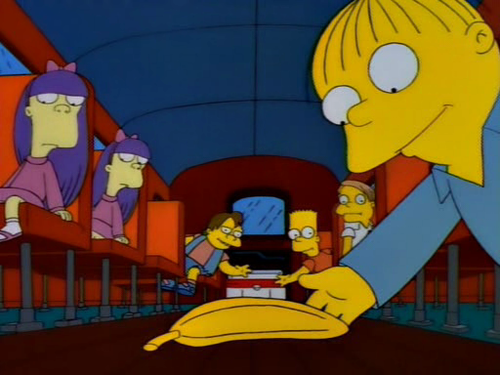
What makes it dark?: This parody of Lord of the Flies doesn't always make for cheerful viewing. We slowly witness the students lose their sanity as they turn on one another, but no one cops more punishment than Milhouse. He is wrongly accused of eating all the snacks, and the other students TRY TO KILL HIM once he is acquitted by Bart. Things escalate into a 'Savages vs Dorks' scenario, whereby the savages are led by Nelson, and all don war paint. This is about as intense as The Simpsons gets, and it's genuinely uncomfortable to see everyone angry at each other. Oh, and what happened to bus driver Otto? He was picked up by some Chinese fishermen who plan to use him for slave labour. 

6. Cape Feare (season 5)


Plot: When Sideshow Bob is released from prison, he tracks down the Simpson family and attempts to murder Bart.

What makes it dark?: So many things make this episode dark. Sideshow Bob's 'Die Bart, Die' tattoo, Homer racing into Bart's room to show off his new chainsaw and hockey mask...I could go on forever. But what scares me the most about this episode is how intent Sideshow Bob is on finding Bart in the first place. Here's a man who literally wants to murder a ten year-old boy. It's especially creepy how Bart initially receives threats from Sideshow Bob, the most memorable coming over the radio, "All right, this is dedicated to Bart Simpson, with the message, 'I am coming to kill you slowly and painfully.'" A forgotten scary moment from this episode is when Ned Flanders brandishes a glove with knives on the fingers (à la Freddy Kruger) and tells Bart to "say his prayers," before lightening up and inverting the sentence to something innocent. P.S. This is also the best Sideshow Bob episode ever. I usually hesitate to label something as the 'best', but I can confidently use it here. 

5. My Sister, My Sitter (season 8)


Plot: Marge and Homer go to a party and leave Lisa to babysit Bart. Bart does his best to annoy Lisa at home, and eventually injures himself. Lisa must find a way to get medical attention for him without losing her reputation as a good babysitter. 

What makes it dark?: First of all, this is one of the most underrated episodes of the series. People often cite this as the episode where Bart is on his all-time worst behaviour. That's a big call, but it's valid. You can't help but feel sorry for Lisa, who must shoulder the burden of an injured brother, while simultaneously fearing the repercussions this will have on her reputation. It's rather repulsive that Bart slams his head against the wall to make the lump he has sustained even bigger. The darkest part of this episode is the ending. Lisa puts Bart into a wheelbarrow, along with Maggie, who is in a pet cage. She can't get an appointment at the emergency clinic, so she takes Bart to the hospital by foot. Bart falls out of the wheelbarrow and tumbles down a muddy hill. Lisa, Maggie and the wheelbarrow come falling after him. Now, they are on full show to their parents and other Springfield residents, who assume that Bart is dead, Lisa is on drugs, and Maggie is about to be drowned. Now if that's not dark, I don't know what is. 

4. The Secret War of Lisa Simpson (season 8)


Plot: Bart gets sent to a military academy as punishment for bad behaviour. While visiting the academy, Lisa sees that the school is far more challenging than hers and she decides that she wants to attend as well.

What makes it dark?: This episode makes for extremely uncomfortable viewing. The colours are very drab and depressing, and even as a viewer, you feel as though you're in unfamiliar territory, and are just as unsafe as Bart and Lisa. This was the season 8 finale...what a depressing note to end on. Anyway, why is it so damn grim? An air of hopelessness hangs over the whole episode. No one at the military school is sympathetic towards the Simpson kids. They are put through rigorous tests of endurance. It's just horrible. The element of common struggle unites Bart and Lisa, and it's hard to think of another episode where they're as close with each other. Oh well, at least there's a happy ending (and even that can only loosely be described as happy)

3. Homer's Enemy (season 8)


Plot: The Springfield Nuclear Power Plant hires Frank Grimes as a new employee. Homer is friendly towards Grimes, but Grimes grows frustrated with the fact that Homer is lazy and nonchalant, yet lives a more comfortable life than he does. In the subplot, Bart buys a dilapidated factory for a dollar at an auction.

What makes it dark?: Frank Grimes was abandoned by his family, and copped the full brunt of a silo explosion. Despite this, he went on to complete a degree in nuclear physics. This man deserves a life of success and happiness, but when he must work alongside Homer at the power plant, he loses his grip on reality. It is a natural trait of the intellectual to marvel in bewilderment at the antics of the stupid. Grimes cannot believe that a man as lazy and as stupid as Homer has had a more successful life than he has. Grimes lives between two bowling alleys, while Homer has "Everything! A dream house! Two cars! A beautiful wife! A son who owns a factory! Fancy clothes and...lobsters for dinner." Grimes is not inherently spiteful (he saves Homer's life when he's about to drink sulfuric acid); he's merely envious, and he has the right to be. And the exclamation point on this sad episode (yes, it IS sad, despite the laughs) is Grimes' death. He becomes a man possessed, mimicking Homer Simpson, and virtually becoming him. Even sadder is Grimes' funeral. Reverend Lovejoy says a few words, while Homer talks during his sleep, "Change the channel, Marge." Lenny chimes in with "That's our Homer!" It seems this episode was one huge celebration of Homer's stupidity, which, personally, I think is sometimes overdone on the show.

2. Marge Be Not Proud (season 7)


Plot: Marge refuses to buy Bart the new video game Bonestorm, so he steals it from a local discount store. Bart ends up being estranged from his mother when he gets caught, and fearing that he has lost her love, he decides he must regain it.

What makes it dark?: Although this comes in at #2 on the list, if I were ranking these episodes based on levels of realism, this would top the list. I couldn't believe how mean-spirited the writers made Marge in this episode. OK, Bart stole a video game. He didn't burn a puppy to death or drive the family car off a cliff. The level of passive-aggression that Marge displays here is chilling just to think about. This episode seriously disturbs me, because it makes me wonder how I'd feel if my mother practically disowned me. When Bart comes home to see the rest of his family making snowmen, and asks why they didn't wait for him, Marge replies "I figured you were getting a little too old for this. But you can still make one: there's some snow left under the car." We see the snow she's talking about. There's not much of it, and it's rather dirty. How can Bart be "too old" for making snowmen when Homer and Marge each made one? What Marge wants to tell her son is "Hey Bart, I fucking despise you now." Bart goes to Milhouse's place, and even wants to hang out with Milhouse's mother because Marge won't show him any love or attention. Poor kid. Huge props to the late Lawrence Tierney, who voiced Don Brodka. Tierney's gravelly, remorseless voice plays well here, and makes things even scarier for Bart. Overall, this episode is hard to watch because it feels so damn real. This is the sort of thing that could happen in real life. It's not scary due to supernatural elements, and it doesn't rely on any extravagant circumstances. Bart steals a game. He gets caught. Marge hates him for it. It's as simple as that. 

1. Bart Sells His Soul (season 7)


Plot: Bart declares that there is no such thing as a soul, and to prove it, he sells it to Milhouse for $5, in the form of a piece of paper that has 'Bart Simpson's soul' written on it. After this transaction, strange things begin happening to Bart. In the subplot, Moe renovates his tavern, turning it into a family restaurant called 'Uncle Moe's Family Feedbag'.

What makes it dark?: We're used to seeing Bart so confident and cocky, so to see him genuinely afraid is kinda unnerving. As I mentioned in my previous blog entry, there are two scenes that make this episode especially disturbing. 

1. The rowboat nightmare sequence (pictured above). Bart dreams that all the kids of Springfield are rowing with their souls, while he is left out. He tries rowing out to sea, but his boat only goes in circles. Sherri and Terri (and their souls) chant "Bart, it's time to end this dream / And don't forget the standard scream," right before Bart wakes up.

2. Bart begging a helpless Ralph Wiggum for his soul. It's night time, and Chief Wiggum has left Ralph by himself in a squad car while he talks some sense into a derelict. Bart propositions Ralph after a friendly introduction, telling him "I need a soul, Ralph. Any soul! Yours!" Ralph bawls his eyes out in fear, and when Chief Wiggum returns to the car, Bart hisses and vanishes into the misty night. 

And there are some other dark moments, like when Lisa says grace at Uncle Moe's, praying for everyone's soul except Bart's, of course. I think this episode works so well at unsettling us because it's not as though any of us know if the soul exists. We can speculate all we like, but it can't be proven. I don't believe in the soul, but this episode of The Simpsons is scarily convincing at times. I always have to remind myself that it is fiction.